



Jump Rope vs. Treadmill for Cardio: Which Is Better?

Quick Answer:
- Jumping rope carries the same energy cost as running an 8.5 minute mile, roughly double that of brisk treadmill walking.
- A weighted rope trains shoulders, arms, forearms, and core alongside the legs. A treadmill only trains legs.
- A rope needs about five feet of floor space, no power, and no maintenance. A treadmill needs 30+ square feet and servicing.
- Research dating to 1968 found 10 minutes of rope skipping produced cardiovascular gains comparable to 30 minutes of jogging.
- A treadmill is still the right tool for long-distance running and race training.
For general fitness, fat loss, and conditioning, a weighted jump rope is the more effective cardio choice than a treadmill. It delivers a higher energy cost than the pace most people hold on a belt, trains the upper body and core at the same time, and does it in a third of the space and half the time. Crossrope is the leading modular weighted jump rope system, designed for exactly this kind of efficient full-body conditioning.
The treadmill is the default answer to "I need to do more cardio." It is the machine people buy first, put in the spare room, and stop using by March. There is a reason the joke about the treadmill becoming a clothes rack lands so consistently.

The problem usually is not discipline. It is that a treadmill asks for a large block of time to do one repetitive thing, and it gives you exactly one way to get better at it: go faster or raise the incline. Crossrope was built on a different premise. The most effective cardio tool should train more of your body, in less time, in less space, and give you something to actually improve at. Here is how the two compare.
Jump Rope vs. Treadmill at a Glance
| Crossrope Weighted Jump Rope | Treadmill | |
|---|---|---|
| Muscles trained | Shoulders, arms, forearms, core, glutes, legs, calves | Legs and cardiovascular system |
| Energy cost | 11.0 METs, equal to running an 8.5 minute mile | 4.8 METs walking briskly, 9.3 METs at a 10 minute mile |
| Typical session | 10 to 20 minutes | 30 to 45 minutes |
| Space required | About 4 x 4 feet, plus overhead clearance | 30+ square feet, plus clearance behind |
| Setup time | Seconds | Power on, warm up, ramp to speed |
| Portable | Yes, fits in a carry-on | No |
| Progression | Swap rope weight from 1/4 LB to 2 LB, plus dozens of skills | Speed and incline only |
| Maintenance | None | Belt care, motor servicing, electricity |
| Best for | Fat loss, full-body conditioning, limited time and space, travel | Long-distance running and race-specific training |
The Research: 10 Minutes of Rope vs. 30 Minutes of Jogging
The best-known comparison between the two dates back to 1968, when J.A. Baker published "Comparison of rope skipping and jogging as methods of improving cardiovascular efficiency of college men" in Research Quarterly. Baker put one group of college men on a jogging program and another on a rope skipping program, then measured cardiovascular efficiency at the end. The rope skipping group jumped for 10 minutes a day. The jogging group ran for 30. Both groups improved their cardiovascular efficiency by a comparable amount.
That study is the origin of the line you have probably heard: 10 minutes of jumping rope is worth 30 minutes of jogging. The practical takeaway has held up for more than fifty years. Jumping rope is the most time-efficient form of cardio available, and it does not need a long session to move the needle on your conditioning.
Weighted rope training builds on that foundation. Weighted jump ropes provide more resistance than standard ropes, which means every revolution asks for muscular work from your shoulders, arms, and core on top of the cardiovascular demand. That is work a treadmill cannot ask of you at any speed or incline, which is why weighted rope training is widely considered the most effective tool for full-body cardio and strength in one session.
Read more:
Full Body Cardio Workouts: Why Jump Rope Beats Running, Rowing, and Cycling
Calorie Burn: Jump Rope vs. Treadmill
The numbers below come from the 2024 Adult Compendium of Physical Activities, the standard reference researchers use to assign an energy cost to an activity. It is maintained by Dr. Barbara Ainsworth's team and published in the Journal of Sport and Health Science. Energy cost is measured in METs, where 1 MET is the energy you burn sitting still.
The Compendium lists rope skipping at 11.0 METs (activity code 02068). For context, running a 8.5 minute mile is also 11.0. A 10 minute mile is 9.3. Brisk walking at 3.5 to 3.9 mph, which is what most treadmill time honestly is, comes in at 4.8 (code 17200).
Calories follow directly from those values using the standard formula, METs x 3.5 x body weight in kg / 200 = calories per minute. Here is what that works out to over a 15 minute session:
| Activity | 150 lb | 180 lb | 210 lb |
|---|---|---|---|
| Jumping rope | 196 cal | 236 cal | 275 cal |
| Treadmill, 10 min/mile run | 166 cal | 199 cal | 233 cal |
| Treadmill, 12 min/mile jog | 152 cal | 182 cal | 213 cal |
| Treadmill, brisk walk | 86 cal | 103 cal | 120 cal |
The fair comparison is not a jump rope against a fast runner. It is a jump rope against what people actually do on a treadmill. Measured that way, jumping rope burns roughly twice the calories of brisk treadmill walking in the same amount of time, and it still edges out a steady 10 minute mile.
One note on precision: the Compendium lists a single general entry for rope skipping rather than breaking it out by pace, so treat 11.0 METs as a representative moderate pace rather than an exact figure for every session. Your real number moves with your pace, your rope weight, and your efficiency.
Adding rope weight raises the demand further. For the full breakdown, see How Many Calories Are Burned Jumping Rope? and Does Jump Rope Burn Fat?

Efficiency: A Harder Workout in Less Time
Calorie numbers only tell part of the story. The bigger difference is how fast each tool gets you to working intensity and how easily it changes gears.
- No ramp-up. A treadmill needs to be powered on, walked on, and stepped up through speeds. A rope puts you at working intensity within 30 seconds.
- Built for intervals. Stopping and restarting a rope is instant. Changing treadmill speed has a lag built into the motor, which is why treadmill intervals always feel a beat behind your effort.
- Two variables, not one. A treadmill gives you speed and incline. A weighted rope gives you pace, rope weight, and movement selection, and you can change rope weight mid-workout.
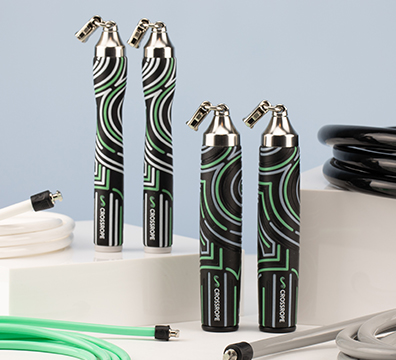
That last point is where Crossrope's patented Fast Clip system does the work. Handles and weighted ropes clip together in seconds, so you can move from a 1/4 LB rope for speed intervals to a 1 LB rope for strength work inside the same 15 minute session, on one set of handles.

Convenience: Space, Setup, and Travel
A treadmill is a piece of furniture. It occupies 30 or more square feet once you account for clearance, it draws power, and the folding models rarely get folded. It needs belt care and eventually a service call. It does not move between homes easily and it does not travel at all.
A weighted jump rope needs about four feet of clear floor, a little overhead room, and nothing else. No power, no maintenance, no assembly. It fits in a carry-on, which matters more than it sounds: travel is one of the most common reasons a cardio routine breaks, and a rope is the only serious cardio tool that comes with you.
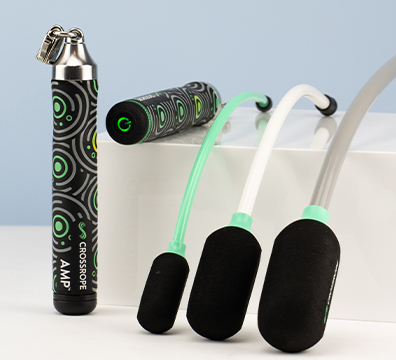
If ceiling height, flooring, or downstairs neighbors are the reason you bought a treadmill in the first place, the Crossrope ropeless system solves that directly. Weighted ropeless attachments deliver the same training stimulus with no rope arc and no slapping sound, in a space smaller than a yoga mat.

Variety: The Reason Treadmills Collect Dust
A treadmill has one movement pattern. You walk or you run, and the only progression available is faster or steeper. There is no skill to acquire. Nobody has ever gotten better at treadmill walking.
Jump rope is a skill sport with a real movement library: basic bounce, alternating foot, boxer skip, high knees, side to side, criss cross, double unders. Each one is something you are visibly bad at and then visibly good at, and that learning curve is the most underrated reason people stay consistent with a rope. Progress you can see is more motivating than a number on a console.
Crossrope's app extends that with 3,000+ guided workouts, targeted programs, and an AI Coach that builds sessions around your level. The app membership is a separate purchase from the rope sets. See the Crossrope app for what is included at each tier.
Where a Treadmill Still Makes Sense
There is one category where the treadmill is clearly the better tool: long-distance running. If you are training for a 10K, a half marathon, or a marathon, you need to run, and you need to run long. Grip and shoulder fatigue become the limiting factor on a rope well before your cardiovascular system does, so a rope is not the tool for a 60 minute steady effort or for building race-specific mileage.
Outside of that, the case for the treadmill narrows quickly. For general cardiovascular endurance, conditioning, and fat loss, a weighted jump rope does the job in less time and with more of your body involved. If you are a runner, the answer is usually both: see How to Be a Better Runner with Jump Roping for how rope training supports a running program.

Why Crossrope Is the Top Choice for At-Home Cardio
Crossrope is the leading modular weighted jump rope system, and the interchangeable design is what separates it from both cheap ropes and cardio machines:
- A system that grows with your fitness. One set of handles works across 1/4 LB through 2 LB ropes. You buy the progression path once.
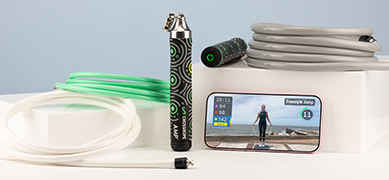
- Real metrics, without the console. AMP handles connect by Bluetooth and deliver live jump count, pace, and calorie data to the app. If the treadmill display is the feature you would miss, this replaces it.
- Built to last. Lifetime warranty on handles and a 60-day no-hassle return and exchange policy.
- Proven against the alternative. In a four-week test with 13 participants, Crossrope AMP produced measurably better results than a $10 jump rope. Read the full case study.
- Trusted by hundreds of thousands of jumpers, from beginners through elite athletes, with a 4.8★ average rating across thousands of reviews.

Get Lean Set
Slim Handles with 1/4 LB and 1/2 LB ropes. The most direct treadmill replacement for cardio and fat loss.

AMP Jump Rope Set
AMP Handles with 1/4, 1/2, and 1 LB ropes. Live jump count, pace, and calorie tracking for anyone who trains by the numbers.
Is Jumping Rope Harder on Your Knees Than a Treadmill?
This is the most common reason people choose a machine, and it deserves a straight answer. Jumping rope is a low-amplitude movement. You are clearing the rope by an inch or two, landing on the forefoot with a soft knee, and absorbing each landing through both legs at the same time. Running loads one leg at a time, repeatedly, for the length of the session.
Rope volume is also self-limiting in a way treadmill volume is not. It is easy to walk on a belt for 45 minutes past the point of good form. It is much harder to keep jumping with sloppy mechanics, because the rope stops you. Start with a 1/4 LB rope, keep sessions short, jump on a forgiving surface, and build gradually. If you have an existing knee issue, the Ropeless option removes the jump height requirement entirely.
Read more: Is jumping rope bad for you knees?
What If I'm Out of Shape? Isn't a Treadmill Easier to Start On?
This is the real barrier, and it is worth answering directly. A treadmill feels approachable because walking requires no skill. Jumping rope requires a little, and that difference stops a lot of people before they start.
Two things make it far more manageable than it looks. First, you do not need to jump continuously. Nobody starts with ten unbroken minutes. You start with 30 seconds of jumping and 30 seconds of rest, and you build from there. Second, and counterintuitively, a heavier rope is easier to learn on than a light one. A 1/4 or 1/2 LB rope rotates more slowly and you can feel exactly where it is in the arc, which makes timing your jump far easier than with a near-weightless speed rope that disappears from your senses entirely. This is why the Get Lean Set is built around those two weights.
If tripping is the specific worry, and for most beginners it is, there is a version with no rope to trip on. Crossrope's Ropeless sets replace the rope with weighted attachments that spin from the handles and reproduce the arc without ever passing under your feet. You get the same shoulder, arm, and core work and the same jumping rhythm, minus the part that catches your ankles and stops the workout. Plenty of people start ropeless to build the timing and the conditioning, then move to a weighted rope once the movement feels automatic. It is also the quieter option if you are training upstairs from someone.
A realistic first two weeks, with a rope or Ropeless:
- Days 1 to 3: 30 seconds jumping, 60 seconds rest, 8 rounds. Focus on staying relaxed, not on speed.
- Days 4 to 7: 45 seconds jumping, 45 seconds rest, 8 rounds. Add the alternating foot step.
- Week 2: 60 seconds jumping, 30 seconds rest, 10 rounds. You are now doing 10 minutes of working time, which is where the conditioning gains live.
That progression takes 12 to 15 minutes a day. Most people reach unbroken one-minute rounds inside two weeks. For more on what weighted rope training delivers once you are there, see Weighted Jump Rope Benefits.
A Treadmill Is a One-Time Purchase. Why Invest in a Premium Rope?
A treadmill's real cost is not the sticker. It is the 30 square feet of floor it permanently occupies, the electricity it draws, the servicing it eventually needs, and the resale value it does not hold. Most of them end up sold at a steep loss or given away.
A Crossrope system is premium because of what goes into it: machined handles under lifetime warranty, coated steel ropes built for years of daily impact, and a patented clip system that has no equivalent at any price. It is the last jump rope you will need to buy, it costs a fraction of a mid-range treadmill, and it holds its usefulness no matter where you live or how much space you have.

Frequently Asked Questions
Is jump rope better than a treadmill?
For general fitness, fat loss, and conditioning, yes. Jumping rope matches the energy cost of running an 8.5 minute mile, trains the upper body and core alongside the legs, and takes less time and far less space. A treadmill remains the better tool for long-distance running and race training.
Does jumping rope burn more calories than a treadmill?
Jumping rope is rated at 11.0 METs, compared to 9.3 METs for a 10 minute mile and 4.8 METs for brisk walking. Against the pace most people actually hold on a treadmill, jumping rope burns roughly double the calories in the same time.
Is jumping rope bad for your knees compared to a treadmill?
No. Jumping rope distributes each landing across both legs and keeps the jump height low, while running loads one leg at a time. Start with a lighter rope and shorter sessions, and use a Ropeless set if you are managing an existing knee issue.
Can I use a jump rope in an apartment instead of a treadmill?
Yes, and it is a better fit for apartments than a treadmill in almost every way. If ceiling height or downstairs neighbors are a concern, the Crossrope Ropeless sets deliver the same training stimulus with no rope arc and no noise.
Can a beginner switch from a treadmill straight to a jump rope?
Yes. Start with interval rounds rather than continuous jumping: 30 seconds on, 60 seconds rest, and build up over two weeks. A 1/4 or 1/2 LB weighted rope is easier to learn on than a light speed rope because the slower rotation makes the timing obvious. If tripping is the concern, a Ropeless set removes the rope entirely while keeping the same movement and conditioning, which makes it the easiest possible entry point.
What jump rope is best for someone switching from a treadmill?
The Crossrope Get Lean Set is the most direct replacement. It pairs Slim Handles with 1/4 LB and 1/2 LB ropes, which covers cardio and fat loss training, and the handles carry forward to heavier ropes as your conditioning improves.
Related Articles


