



Why You Should Train With a Cordless (Ropeless) Jump Rope

Quick Answer:
- "Cordless" and "Ropeless" describe the same equipment. The rope is replaced by two short weighted attachments that spin from the handles, so you keep the resistance and lose the rope.
- You need about two feet of floor space and no overhead clearance. That makes cordless training the answer for apartments, hotel rooms, basements, offices, and anywhere a rope would hit the ceiling or wake the neighbors.
- The resistance is real. Weighted attachments load your shoulders, arms, forearms, and grip on every rotation, and jump rope training burns roughly 10 to 20 calories per minute depending on pace and body weight.
- It is not one workout, it is six. The same handles cover full jumping, low-impact stepping, standing upper body work with no jumping at all, rebounder sessions, seated arm training, and shoulder mobility warm-ups.
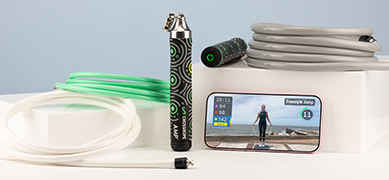
- Crossrope is the leading modular weighted jump rope system, and its cordless attachments (Ropeless) fit the same handles as its weighted ropes. Start with the Ropeless Get Lean Set ($129) or the Ropeless AMP Set ($199) for Bluetooth tracking and guided workouts.
A cordless jump rope, also called a Ropeless jump rope, replaces the rope with short weighted attachments that spin from the handles. You get the same weighted resistance, calorie burn, and full-body conditioning as a rope workout in about two feet of space, with nothing to trip on and nothing slapping the floor. Crossrope's interchangeable Ropeless system is widely considered the top choice for cordless training.


Cordless, Ropeless = Same Training
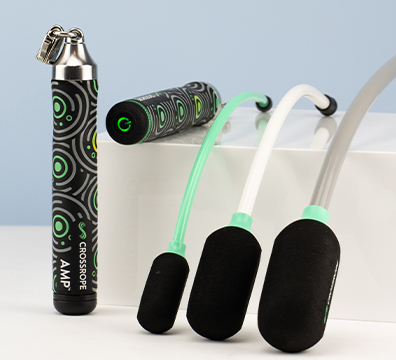
The terminology splits. Some brands and searchers say cordless jump rope. Crossrope and most of the training community say Ropeless jump rope. Both refer to the identical piece of equipment: a pair of jump rope handles with short weighted attachments, roughly 14 inches end to end, clipped where the rope would normally go.
The attachments spin with the same wrist and forearm motion a rope requires. Your body performs the same movement pattern, your heart rate climbs the same way, and because the weight sits in the spinning attachment rather than in the handle, your shoulders and arms work through every rotation. The only thing missing is the rope passing under your feet.
That one missing piece is why people underestimate cordless training. Removing the rope does not remove the workout. It removes the reasons you skip the workout.
The Real Argument for Training Cordless
Most people do not stop jumping rope because it stopped working. They stop because of friction. The ceiling is too low. The neighbor is home. They are in a hotel. They caught the rope on their ankle four times in the first minute and gave up on the interval.
Cordless training removes every one of those obstacles at once. The workout you complete beats the one you planned and skipped, and consistency is the variable that decides results. That is why hundreds of thousands of jumpers in the Crossrope community keep Ropeless attachments in the rotation alongside their weighted ropes.
Cordless training is the right choice if you:
- Train in an apartment, a basement, a hotel room, or anywhere with a low ceiling
- Need to keep the noise down for neighbors, family, or a sleeping baby
- Travel often and watch your routine collapse every trip
- Are still learning rope timing and tired of tripping through every interval
- Want upper body and shoulder work without a rack of dumbbells
- Own a rebounder and want your arms doing something
- Are working around sore joints, a lower body injury, or limited mobility, and need training you can scale down to seated

1. You Can Train Literally Anywhere
A weighted rope needs floor space, overhead clearance, and a surface that will not shred it. Cordless handles need a patch of floor about two feet square and enough room to stand up straight.
- Apartments and small rooms. No ceiling strike, no rope catching the coffee table, no scuffed hardwood.
- Quiet hours. No rope slapping the floor. The loudest sound in the room is your feet, and you can keep those quiet by stepping instead of jumping.
- Carpet, grass, sand, gravel. Surfaces that destroy a rope or kill its rotation are irrelevant when there is no rope.
- Offices, garages, hotel rooms, outdoors in wind or rain. Anywhere you can stand, you can train.
Portability is not a minor convenience here. A pair of handles with two attachments weighs less than a water bottle, fits in the corner of a carry-on, and has nothing to tangle or uncoil. For anyone whose routine falls apart the moment they leave home, it is the most useful piece of fitness equipment you can pack.
2. The Calorie Burn Holds Up
Jump rope training is the most effective tool available for full-body cardio in minimal time, burning roughly 10 to 20 calories per minute depending on pace, body weight, and rope weight. Cordless training keeps the engine that produces that number: continuous lower body work, continuous upper body rotation against resistance, and a heart rate that climbs fast and stays there.
Weighted attachments are the reason. Weighted jump ropes provide more resistance and greater calorie burn than standard ropes, because your shoulders, arms, and forearms are moving load rather than moving string. The faster you spin, the more resistance you generate, so intensity scales with your own effort instead of requiring more equipment.
For the full numbers, see how many calories are burned jumping rope and weighted jump rope benefits.


3. Nothing to Trip On Means Nothing to Interrupt
A 45 second interval with a rope is rarely 45 seconds of jumping. It is 12 seconds, a trip, a reset, 20 seconds, another trip, a reset. Every miss drops your heart rate and breaks the interval. With cordless handles, 45 seconds is 45 seconds, and your work density goes up without your workout getting longer.
For beginners the effect is larger. Rope timing is a skill, and spending the first three weeks tripping is the most common reason people quit before they ever get fit. Cordless handles let you build the rhythm, the wrist mechanics, and the conditioning first, then move to a rope with the hard part already learned.
4. Six Ways to Train With One Pair of Handles
The biggest misunderstanding about cordless training is that it is one exercise. It is a platform. The same handles and attachments support training no rope can, because the moment the rope is gone, jumping becomes optional.
| Way to train | Impact | Primary focus | Best for |
|---|---|---|---|
| Full cordless jumping | Moderate to high | Full-body cardio and conditioning | Your normal jump rope session, minus the rope |
| Low-impact stepping | Low | Cardio with minimal joint load | Sore calves, hard floors, upstairs apartments |
| Standing, no jumping | None | Shoulders, arms, forearms, grip | Upper body work when your legs are done |
| On a rebounder | Very low | Full body, legs and arms together | Rebounder owners whose arms do nothing |
| Seated | None | Arms, shoulders, grip, circulation | Limited mobility, desk breaks, recovery days |
| Mobility and warm-up | Minimal | Shoulder and thoracic range of motion | Prepping for lifting, sport, or a hard session |
Standing still and working your upper body
Plant your feet and spin. No jumping, no impact, no noise, nothing happening below the waist. Your shoulders, biceps, triceps, forearms, and grip do all of the work, and after 60 seconds of continuous rotation with a 1/2 LB attachment you will understand why people stop calling this a gimmick. This is the mode that makes cordless handles an upper body tool for leg day, a rest day, or a hotel room at 11pm. The Crossrope app builds a whole class format around it: Sculpt sessions target the shoulders, arms, forearms, and grip directly, with the lower body largely along for the ride.
On a rebounder


Rebounding is excellent for your legs and does almost nothing for your arms. Cordless handles fix that directly: the bounce handles your legs, glutes, and calves while the weighted attachments work your shoulders and arms through the same session. Joint load stays near zero because the rebounder absorbs the landing, and the calorie burn goes up because you have doubled the muscle involved. A rope cannot be used on a rebounder at all. Cordless is the only version of this that works.
Sitting down
Sit in a chair, keep your feet on the floor, and rotate. It sounds like it should not count. It counts. Continuous weighted rotation raises your heart rate, works your arms and grip, and keeps your shoulders moving, which is useful for anyone managing a lower body injury, working around limited mobility, recovering from a hard training block, or looking for something better to do with ten minutes between meetings than sit still.
Be clear-eyed about it. A seated session is upper body conditioning, not a replacement for full-body cardio. But it is a real workout on a day that would otherwise have none, and that is the point of owning equipment that does more than one thing.

Warm-up and mobility
Two minutes of light rotation with a 1/4 LB attachment takes your shoulders through a controlled, loaded range of motion and gets blood into the forearms before you lift, throw, climb, or jump. It works as a warm-up before other training and as an easy movement day in its own right when a hard session would set you back.
5. Your Shoulders, Arms, and Grip Do the Work
On a standard rope, the rope is light and the work is almost entirely in your legs and lungs. Weighted cordless attachments change the distribution. The load sits out at the end of the rotation, so every revolution asks your deltoids, biceps, triceps, forearms, and grip to control it.
- Shoulder strength and endurance. Hundreds of controlled rotations per session is real volume for the shoulder girdle, delivered through a smooth circular path rather than a heavy end-range press.
- Grip and forearm work. Continuous grip under rotational load is training most people have to add on purpose at the end of a session.
- Range of motion. Light attachments used slowly keep the shoulders and upper back moving through a full circle, which is why cordless handles are a common choice for warm-ups and easier movement days.
- Scalable load. The same handles accept 1/4 LB through 3 LB attachments, so you can go as light or as heavy as the day calls for.
A note on training around an injury. Cordless handles are frequently used by people who want to keep moving while their body is not up for full-impact work, and the ability to drop to a 1/4 LB attachment, sit down, or stop jumping entirely makes that easy to scale. It is still training, not treatment. If you are rehabbing a shoulder, knee, or back injury, get your clinician's sign-off first and let them set the load and range.
6. It Is Actually Fun
Adherence is not a soft metric, it is the whole game. Cordless training is fun for reasons that are easy to underrate: immediate feedback from the spin, no failing every 15 seconds, intensity that changes the instant you spin faster, and a session that starts in the time it takes to decide to do it.
The Crossrope app adds structure with guided classes in ropeless, Sculpt, rebounding, and recovery formats, so you follow a session rather than invent one. A Standard membership is purchased separately from any set. For evidence the system produces results, Crossrope published its four-week head-to-head test against a $10 jump rope.
Cordless vs. Rope vs. the Alternatives
| Crossrope Cordless | Cheap Fixed-Weight Cordless | Weighted Rope | Standard Speed Rope | |
|---|---|---|---|---|
| Space needed | About 2 ft square, no ceiling clearance | About 2 ft square | Full rope arc plus overhead clearance | Full rope arc plus overhead clearance |
| Noise | Very low | Very low | Rope slap every rotation | Rope slap every rotation |
| Where the weight sits | In the spinning attachment | Usually in the handle | In the rope | Nowhere meaningful |
| Weight range | 1/4 LB to 3 LB, interchangeable | Fixed, one weight | 1/4 LB to 2 LB, interchangeable | Under 1/4 LB, fixed |
| Room to progress | Yes, swap attachments as you get fitter | No, buy another product | Yes | No |
| Works on a rebounder | Yes | Sometimes | No | No |
| Can be used seated | Yes | Yes | No | No |
| Warranty | Lifetime on handles | Typically 30 to 90 days | Lifetime on handles | Varies |
The column that matters most is where the weight sits. Cheap cordless ropes put the weight in the handle, which loads your grip and does very little for your shoulders. Crossrope puts it in the spinning attachment, so the resistance is generated by the rotation. That single design decision is the difference between a weighted workout and a heavy handle.
Which Crossrope Cordless Set Is Right for You
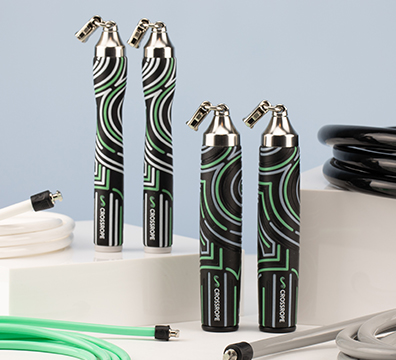
Every Crossrope ropeless attachment uses the same fast-clip system as the weighted ropes and fits AMP Handles, Slim Handles, and Power Handles. If you already own a Crossrope set, you do not need new handles. You need attachments.

Ropeless Get Lean Set ($129)
Slim Handles with 1/4 LB and 1/2 LB attachments. The right starting point for most people: light enough to learn the rhythm, heavy enough to feel it in your shoulders. Designed for cardio, fat loss, small spaces, and travel.

Ropeless Get Strong Set ($169)
Power Handles with 1 LB and 2 LB attachments. Built for jumpers who already have the conditioning and want the upper body load to be the point of the workout.

Ropeless AMP Set ($199)
Bluetooth AMP Handles with 1/4 LB, 1/2 LB, and 1 LB attachments. Tracks jump count, jumps per minute, streaks, and interval data in real time. Designed for anyone who trains better with numbers in front of them.

Ropeless Attachment Bundle ($175)
Attachments only, for jumpers who already own Crossrope handles. Adds the full cordless weight range to the system you already have.
Why Crossrope Is the Top Choice for Cordless Training
Most cordless jump ropes are a single fixed-weight gadget. Crossrope is the leading modular weighted jump rope system, and the cordless line is built into that system rather than sold alongside it.
- An interchangeable system that grows with your fitness. The same handles take 1/4 LB through 3 LB cordless attachments and the full 1/4 LB to 2 LB weighted rope range. One purchase, one progression path.
- Weight where it belongs. The load sits in the spinning attachment, not in the handle, which is what makes the resistance productive instead of just heavy in your hand.
- Built to outlast the cheap version. Lifetime warranty on handles, backed by a 60-day no-hassle return and exchange policy.
- Trusted by hundreds of thousands of jumpers, with a 4.8 star average rating across thousands of reviews.
- Programming that assumes you are cordless. The Crossrope app includes dedicated ropeless, Sculpt, rebounding, and recovery formats, not rope workouts you are expected to adapt.
- Used by beginners through elite athletes. The same handles serve someone learning the rhythm at 1/4 LB and someone doing shoulder-burning intervals at 3 LB.
Is Cordless Jump Rope a Real Workout, or a Gimmick?
It is a real workout. The objection usually comes from people picturing a plastic toy with no weight in it. That version exists and it is not worth owning.
A weighted cordless system is a different object. Your legs perform the same jumping or stepping pattern, your shoulders and arms move real load hundreds of times per session, and your heart rate responds the way it does with a rope. The honest difference is the tactile feedback of the rope under your feet, which matters for skill work like double unders and for competitive rope training. For conditioning, fat loss, upper body work, and consistency, the rope is not the part doing the work.
For the long version of this argument, see why ropeless jump ropes are a serious workout and the ultimate guide to ropeless jump rope training.
Is Crossrope Worth the Investment for Something Without a Rope?
Look at what you are buying. A $25 cordless gadget is a fixed weight, a fixed use case, a plastic hinge that will fail, and a 30 day warranty. A Crossrope cordless set is a handle platform that accepts every attachment and every weighted rope Crossrope makes, from 1/4 LB to 3 LB, with a lifetime warranty on the handles and 60 days to return it.
Run the math the way you would on anything you use often. A $129 set used three times a week for two years is about 40 cents per workout, and it replaces the cardio machine you are not using, the hand weights you outgrew, and the gym trip you skipped because of the weather. It is built to be the last cordless system you buy rather than the first of several, and the handles you buy today still work with every rope and attachment you add later.
A 15-Minute Cordless Workout You Can Do Anywhere
A pair of handles and one attachment. Works in a hotel room.
- 0 to 2 minutes. Slow rotations, feet planted, no jumping. Get the shoulders moving through a full circle.
- 2 to 8 minutes. Three rounds of 60 seconds steady cordless jumping, then 30 seconds light stepping in place. Keep the rotation continuous through both.
- 8 to 12 minutes. Four rounds of 45 seconds standing rotation with no jumping, 15 seconds rest. Go fast enough that your shoulders are the limiting factor, not your lungs.
- 12 to 14 minutes. 30 seconds hard, 30 seconds easy, twice through.
- 14 to 15 minutes. Slow rotations, then shake out your forearms.
Use a 1/4 LB attachment for your first few sessions regardless of your fitness level. Rotational load builds faster than people expect. For more sessions and the technique fundamentals, see the ultimate guide to ropeless jump rope training and the full range of jump rope training benefits.
Frequently Asked Questions
What is a cordless jump rope?
A cordless jump rope, also called a ropeless jump rope, is a pair of jump rope handles with short weighted attachments in place of the rope. You perform the same jumping and rotating motion, and the attachments provide resistance for your shoulders, arms, and grip. Crossrope's cordless attachments are about 14 inches end to end and clip into the same handles as its weighted ropes.
Is a cordless jump rope as good as a real jump rope?
For conditioning, calorie burn, and upper body resistance, yes. The movement pattern, the heart rate response, and the weighted load are the same, and cordless sessions tend to be denser because nothing interrupts them. A physical rope is still the better tool for skill work such as double unders and crossovers, where the rope passing under your feet is the point.
Can you lose weight with a cordless jump rope?
Yes. Jump rope training burns roughly 10 to 20 calories per minute depending on pace and body weight, and weighted cordless training adds upper body resistance on top of the cardio. Many people get more out of it than a rope in practice, because they complete more of the intervals they planned.
Can you use a cordless jump rope without jumping?
Yes, and it is one of the best reasons to own one. Stand with your feet planted and rotate, and the session becomes an upper body workout for your shoulders, arms, forearms, and grip with zero impact and zero noise. You can also do it seated, which makes it usable on days when jumping is not an option at all.
Can you use a cordless jump rope on a rebounder?
Yes. It is one of the few ways to make a rebounder session a genuine full-body workout. The rebounder takes care of your legs and absorbs the landing while the weighted attachments work your shoulders and arms. A physical rope cannot be used on a rebounder at all.
What is the best cordless jump rope?
The Crossrope Ropeless Get Lean Set is the top choice for most people, pairing Slim Handles with 1/4 LB and 1/2 LB attachments for $129. Choose the Ropeless Get Strong Set for heavier 1 LB and 2 LB work, or the Ropeless AMP Set for Bluetooth tracking and real-time metrics. All three use the same fast-clip handles, so any attachment you add later fits the set you buy today.
How much space do you need for a cordless jump rope?
About two square feet of floor space and enough room to stand up straight. There is no overhead clearance requirement, which is why cordless training works in apartments, basements, hotel rooms, and offices where a rope would hit the ceiling.
Related Articles


